
Last updated November 17, 2026
New windows and doors improve comfort, cut energy bills and add long-term value to your home. Westlight Windows & Doors Henderson pairs proven product lines with a local vetted installing partner for lasting performance - and a price put in writing.
Choose your installer
The unit is half the job - the install is the other half. Background-checked local installers measure, set, seal and insulate every opening, and they know the lines we quote inside and out.
Select the right products
Compare styles, materials and glass packages side by side until the fit is right for your rooms, your budget and your goals. The product-line comparison below is the place to start.
Prepare your home for install
Before install day we walk you through a short checklist - furniture pulled back, treatments down, a clear path to each opening - so install day is watch-it-happen, not scramble.
Compare the Lines We Quote
Every project is priced on the same lines, side by side - the price indicators below are relative, and your consultant shows exact numbers on your actual openings.
PGTThe line homeowners arrive naming - the most impact certifications in the industry$$$
- More impact certifications than any other line we quote
- WinGuard, EnergyVue and ClassicVue Max systems built for every wind zone
- 99% on-time delivery keeps your install date on the calendar
CGIThe heavyweight impact line$$$$$
- Large-missile impact ratings for the strictest wind zones
- Architectural-grade aluminum with commercial-depth frames
- The line we quote when protection is the whole point
CWSThe value pick$$
- Vinyl systems built to strict wind codes
- Strong energy packages at the friendliest price point
- The smart start for whole-home replacements on a budget
ESWSlim lines, big glass$$$$
- Narrow-sightline aluminum for modern elevations
- Oversized openings and floor-to-ceiling glass
- Impact-rated without the bunker look
ECOThe aluminum impact workhorse$$$
- Factory-built aluminum impact systems
- A strong price-to-protection ratio for coastal homes
- Proven lines with short lead times
Window Replacement Troubleshooting: Common Problems and How to Fix Them
A foggy double-pane window looks like a failed seal. In Henderson, it often isn’t. We’ve pulled units where the glass was fine and the real problem was a weep hole the installer never opened, so condensation had nowhere to go and backed up inside the wall cavity. By the time the homeowner noticed the cloudiness, water had been sitting behind the drywall for a year. That’s the frustrating part of window troubleshooting: the symptom you see is rarely the cause you should be chasing. This guide walks you through diagnosing the actual root cause before you spend a dollar, so you know whether to call the glass manufacturer, the original installer, or someone new.
Quick Answer
Most window problems homeowners blame on bad glass are caused by installation errors that surface 6 to 18 months after the job. A failed glass seal (fog between the panes) is usually a manufacturer warranty issue. A window that sticks, drafts along one edge, or leaks at the frame is almost always a labor issue, and whether you’re covered depends entirely on whether you got the installation warranty in writing. Diagnose the cause first; then decide who to call.
Table of Contents
- Failed Glass Unit vs. Failed Installation: How to Tell the Difference
- Sticking Sashes and Cracked Frames: The Shimming Problem
- Why Caulk Won’t Fix Air Leaks in Desert Climates
- Weep Hole Blockage: What It Looks Like and When to Call
- How to Document Problems So a Warranty Actually Holds
- Hardware, Screens, and Operating Problems You Can Fix Yourself
Failed Glass Unit vs. Failed Installation: How to Tell the Difference
This is the single most important distinction in window troubleshooting, and almost nobody explains it clearly. A failed glass unit and a failed installation produce different symptoms, fall under different warranties, and get fixed by different people. Getting this wrong means months of phone calls to the wrong company.
Signs of a failed glass unit (seal failure between the panes):
- Fogging or a milky haze between the two panes, not on the inside or outside surface
- Condensation that appears between the panes on cool mornings and never dries
- A visible wavy or discolored film trapped inside the sealed assembly
- One pane noticeably hotter or colder than the other when you touch both
Signs of a failed installation:
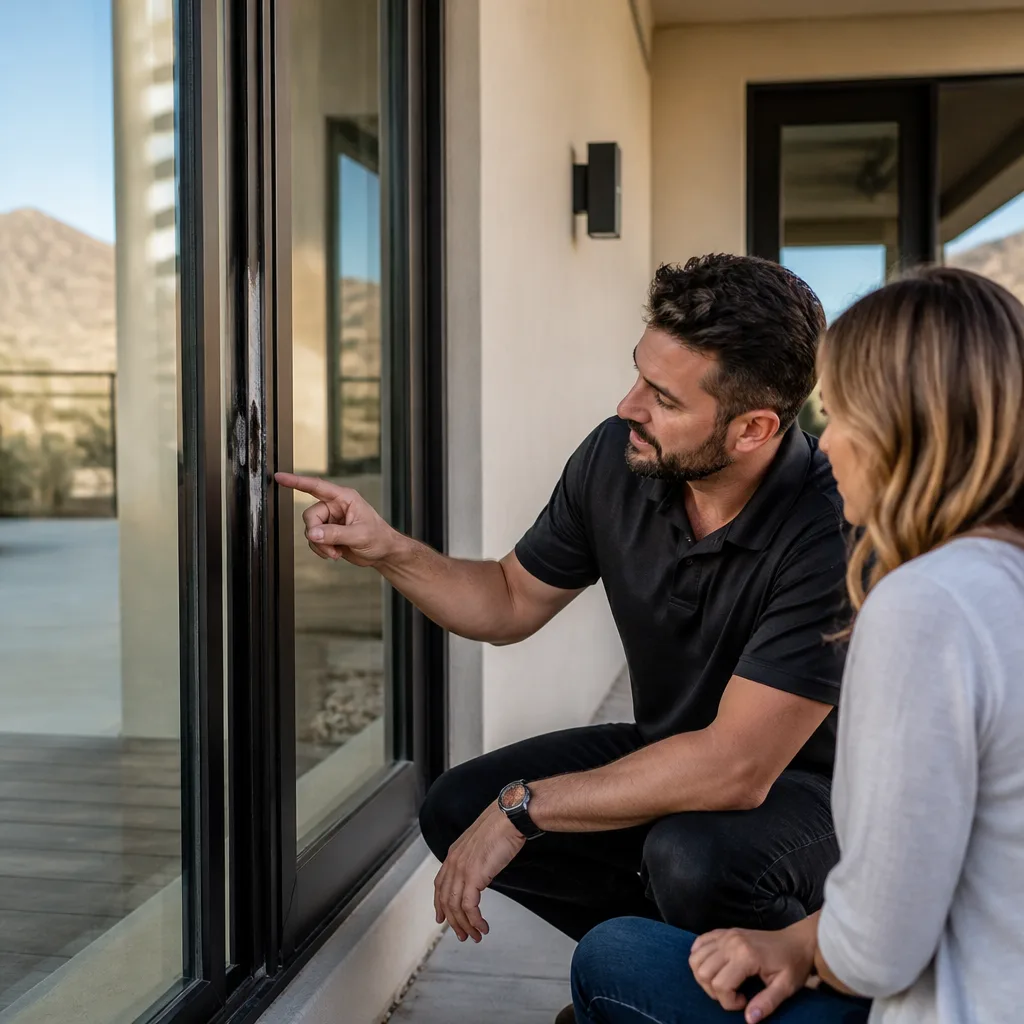
- Drafts along one edge or corner of the frame, not the whole window
- Water staining on the interior drywall or sill after rain
- The sash sticks, drags, or won’t latch squarely
- Caulk lines that crack or pull away within a year of installation
- Visible gaps between the frame and the rough opening when you look closely
If it’s the glass, the manufacturer’s warranty on the sealed unit usually applies, and that’s a product claim. If it’s the installation, you’re dealing with a labor warranty, and that only exists if the original contractor put it in writing. This is exactly why the Kingswell Guarantee puts every promise on paper before work starts. When we install ES Windows or ECO Window Systems units, you get the glass warranty from the manufacturer and a written labor guarantee from us, so there’s no finger-pointing contest later.
Before you call anyone, run this check:
- Wipe the glass inside and out with a dry cloth to rule out surface film.
- Hold a flashlight against the pane at an angle. Fog that stays put when the surface is dry is trapped between panes.
- On a windy day, hold a lit incense stick near the frame edges and watch the smoke. If it wavers at one corner, you have an installation air leak, not a glass failure.
- Note the date and which windows show which symptom. Patterns matter more than individual cases.
Sticking Sashes and Cracked Frames: The Shimming Problem
Henderson sits on some of the most expansive clay soil in the country. That clay swells when it’s wet and shrinks hard when it dries, and our wet-winter, bone-dry-summer cycle works it constantly. A window opening can shift several millimeters over a season, and if the installer didn’t shim the unit correctly, the window takes the stress instead of the framing.
Improper shimming shows up in predictable ways:
- Sticking sashes that operate fine in spring and bind in late summer, or the reverse
- Cracked frames at the corners or where the jamb meets the sill
- Drafts along one edge only, usually the bottom or the hinge side
- Misaligned locks that need a hard shove to engage
- Screws backing out of the frame over time, or a visible gap opening at one corner
A properly shimmed window sits on solid blocking at the load points and lets the frame move independently of the wall. A badly shimmed one is wedged tight against the rough opening, so every bit of soil movement transfers straight into the sash. In our experience across Henderson neighborhoods, this is the most common cause of a “warped” window that really isn’t warped at all, just pinched.
What to check before you call:
- Open and close the sash slowly across a full season. Does it bind only in certain weather?
- Look at the frame corners for hairline cracks. Mark them with tape and photograph them.
- Check whether the screws holding the frame are tight and whether any have backed out.
- Look at the exterior for a gap opening at one corner of the frame.
If a frame is genuinely cracked or the sash has distorted, that’s not a DIY fix, and it’s the kind of failure a written labor warranty should cover. If you’re seeing it on windows that are older or were installed before you owned the house, a proper Window Installation in Henderson with correct shimming and blocking is generally the honest answer.
Why Caulk Won’t Fix Air Leaks in Desert Climates
Caulk is the bandage homeowners reach for first, and in Henderson it almost never holds. Here’s why. A window installed without low-expansion foam in the gap between the frame and the rough opening has an air channel running the full depth of the wall. Caulk seals the surface of that gap, but the cavity behind it is still a chimney. Our summers push 110°F-plus against the exterior and 78°F inside, and that temperature swing plus the UV load breaks down exterior caulk in a single season. The leak comes right back, often worse, because now water gets in behind the failed caulk and can’t drain.
Low-expansion foam (a spray foam designed not to bow frames as it cures) fills the whole cavity, closes the air channel, and insulates the gap. It’s a meaningful difference in our climate. We’ve opened walls in Henderson where a previous installer used a bead of caulk and nothing else, and you could feel hot air moving through the gap on a July afternoon with the window closed.
How to tell whether you have this problem:
- Drafts you can feel with your hand near the frame, especially at the bottom and sides
- Dust collecting in a line along one edge of the interior trim
- Higher cooling bills than neighbors with similar homes and equipment
- Caulk that cracks and pulls away within a year of being reapplied
Re-caulking is a reasonable stopgap if you’re not ready to address it, but be clear with yourself that it’s temporary. A permanent fix means opening the seal, injecting low-expansion foam, and re-sealing properly. That’s installation work, not a homeowner job. When we install ECO Window Systems or Mr-Glass units, the foam and the seal are part of the job, not an add-on.
Weep Hole Blockage: What It Looks Like and When to Call
Weep holes are small openings at the bottom of the window frame that let water drain out of the frame cavity. In a desert climate they’re easy to forget, because for eight months of the year nothing’s draining. Then the monsoon hits, water fills the frame, and if those holes are blocked, it goes sideways into the wall.
From the inside, a blocked weep hole looks like:
- Water staining or a soft spot on the interior sill or drywall below the window after a hard rain
- Paint or drywall bubbling right at the bottom corner of the opening
- A musty smell near the window during and after monsoon season
From the outside, it looks like:
- Visible debris, paint, caulk, stucco, or insect nests plugging the slot at the base of the frame
- Standing water in the bottom channel of the frame after rain
- Water sheeting over the sill instead of draining through
Here’s the practical split. If you can see debris in the slot and clear it with a stiff brush or a piece of wire, that’s a reasonable homeowner maintenance task. Clear the slots, flush them with a hose on low pressure, and confirm water drains freely. But if the weep holes were sealed over by paint or caulk during installation, or if there’s already water damage inside the wall, stop. That’s a contractor call. Drilling or prying at a sealed frame can crack the glass or the frame itself, and interior water damage means the problem got past the window a while ago.
This is the exact failure mode we opened this guide with. In Henderson, a missing or blocked weep hole is one of the most common causes of a “foggy window” that turns out to be a wall cavity full of trapped moisture. If you’re seeing staining plus fog, treat it as an installation issue first.
How to Document Problems So a Warranty Actually Holds
A verbal complaint gets a verbal answer. A documented complaint with dates, photos, and measurements gets a repair. If you want a contractor to honor a labor warranty, the quality of your records decides the outcome more than the strength of your argument.
Build a simple file for each problem window:
- Photograph from three angles – straight on, at an angle to catch the fog or gap, and a close-up of the specific defect. Include something for scale, like a ruler or a coin.
- Photograph the exterior too, especially the weep holes, caulk lines, and the frame corners.
- Note the date and weather each time the problem appears. “Binds when it’s over 95°F” tells a contractor far more than “it sticks sometimes.”
- Write down the window’s location (which room, which wall, which position in the run) and the approximate install date if you know it.
- Keep every communication in writing. Email or text beats phone calls, because a written record is what holds up.
- Reference the specific warranty language from your original contract. Quote it. This is why getting the guarantee in writing at job completion matters so much.
If your original contractor can’t produce a written labor warranty, you’re in a hard spot: the glass may still be covered by the manufacturer, but the installation isn’t covered by anyone. That’s the moment most homeowners start looking for a company that puts the terms on paper. The Window Replacement in Henderson page lays out exactly what our written guarantee covers and for how long.
Hardware, Screens, and Operating Problems You Can Fix Yourself
Not every problem needs a contractor. Some of the most common complaints are hardware and adjustment issues, and a homeowner with a screwdriver and twenty minutes can handle them. Knowing which is which saves you a service call and gives you a clearer picture of what’s actually wrong.
Fixes you can reasonably handle:
- A sash that drags slightly: clean the track, check for debris or a bent roller, and lubricate with a silicone spray (not oil, which attracts dust in our climate).
- A lock that won’t engage: check whether the sashes are seated squarely; a small adjustment to the keeper often solves it.
- A torn screen: screen replacement is straightforward and doesn’t touch the window itself.
- A worn weatherstrip: peel-and-stick replacement weatherstrip is a real fix if the original is compressed or torn.
- Dirt in the weep holes: clear visible debris and flush with low-pressure water.
Leave these to a professional:
- Anything involving the glass, the sealed unit, or the frame itself
- Cracked frames, distorted sashes, or windows that have shifted in the opening
- Water damage inside the wall or at the sill
- Any window on an upper floor where reaching it means working at height
Common Mistakes to Avoid
- Caulking over a draft instead of finding the air channel. In Henderson’s heat, surface caulk fails within a season and can trap water behind it. Fix the cavity, not the surface.
- Assuming fog means bad glass. In our climate, trapped moisture from a blocked weep hole or missing foam often mimics a failed seal. Diagnose first, or you’ll replace a perfectly good unit and still have the leak.
- Not getting the labor warranty in writing. A glass warranty covers the product. Only a written labor warranty covers the installation, and that’s where most failures live. If it isn’t on paper, it doesn’t exist.
- Skipping the documentation. A complaint without photos, dates, and weather notes is easy to dismiss. Build the file as the problem appears, not after it’s been going on for a year.
- Replacing one window when the whole run failed. If windows of the same install batch show the same symptom, the cause is systemic. Fixing one leaves the rest to fail on the same schedule.
- Ignoring soil movement signs. Sticking that comes and goes with the season points to shimming and expansive soil, not a defective sash. Replacing the window without fixing the shimming reproduces the problem.
- Letting an uncertified crew in. Background-checked, uniformed technicians aren’t a luxury. They’re how you know exactly who’s walking through your home and working near your family.
When to Call a Professional
Call a professional when the problem is structural or gets into the wall. That means a cracked frame, a sash that’s distorted rather than just stiff, water staining inside the wall or at the sill, a draft you can’t trace to caulk or weatherstrip, or any window you can’t safely reach. Also call if you can’t get the original installer to honor a written warranty, or if there was never one. Diagnosing the cause is the hard part, and a trained eye can tell a glass failure from an installation failure in about ten minutes. Westlight Windows & Doors Henderson offers free estimates in Henderson, and our technicians have up to 17 years of experience reading exactly these symptoms. Call (844) 797-3435 to schedule yours. We answer live, 24 hours a day.
Frequently Asked Questions
Fog that stays trapped between the panes when the surface is dry points to a failed glass seal, which is usually a manufacturer warranty claim. Fog plus water staining at the sill, a musty smell, or drafts along one edge points to an installation problem like a blocked weep hole or missing foam. Run the incense-smoke test along the frame and photograph both sides before you call anyone. Call (844) 797-3435 for a free diagnosis if you’re not sure which you’re looking at.
Glass seal failures are typically covered by the manufacturer’s product warranty, while installation failures are only covered if you received a written labor warranty. The product and labor warranties are separate, and most homeowner frustration comes from expecting one to cover the other. If you have your original contract, check both sections before calling. Call (844) 797-3435 if you need a written estimate for the repair.
Expansive clay soil under Henderson swells and shrinks with our wet-winter, dry-summer cycle, and windows that weren’t shimmed correctly take that movement directly into the frame. That’s why a sash that operates smoothly in spring can bind hard in August. Sticking that changes with the season is a shimming problem, not a defective window. Call (844) 797-3435 for a free assessment before you replace anything.
Re-caulking is a temporary stopgap, not a fix, in Henderson’s desert climate. If the gap between the frame and the rough opening was never filled with low-expansion foam, there’s an air channel behind the caulk that a surface bead can’t close, and UV plus 110°F summers break the caulk down within a season. The permanent fix is opening the seal, foaming the cavity, and re-sealing. Call (844) 797-3435 for a free estimate on doing it right.
If you have a written labor warranty, send your documented complaint in writing with photos, dates, and the specific warranty language quoted, and keep the record. If you don’t have a written labor warranty, the glass may still be covered by the manufacturer but the installation isn’t covered by anyone. That’s when most homeowners start looking for a company that puts every promise in writing before work begins. Call (844) 797-3435 to talk through your options.
Henderson doesn’t carry the coastal wind-borne debris requirements you’ll find in Florida, so impact-rated glass isn’t a code necessity here. That said, impact-rated products from lines like PGT and CGI offer extra durability for homeowners who want it, and energy performance usually matters more in our climate than impact rating does. A proper installation with correct flashing, foam, and weep holes does more for your home than any single product spec. Visit our Westlight Windows & Doors Henderson home page or call (844) 797-3435 for a free estimate.
The Bottom Line
Most window problems in Henderson aren’t glass problems. They’re installation problems that surface months later: missing foam, blocked weep holes, bad shimming against expansive soil. Diagnose the cause before you spend anything. Check whether the fog is between the panes or on the surface. Run the smoke test on a windy day. Photograph everything with dates and weather notes. And check whether you actually have a written labor warranty, because that single document decides whether you’re covered. If it isn’t in writing, it isn’t a guarantee. Call (844) 797-3435 for a free estimate, and we’ll show you exactly what the Kingswell Guarantee puts on paper before any work starts: a written price, a committed arrival window, a clean job site, and a written guarantee on the work. The 365-Day Done Right Promise means if it fails, we come back and fix it at no charge.
Whether you need a full Door Installation in Henderson or a repair diagnosis, the same principle applies: figure out what actually failed, then hold the right party accountable. That’s the Kingswell Way. Say the price before the work. Show up in the window we gave. Leave the place cleaner than we found it. Put the guarantee in writing. Come back if it fails. West light is the late-afternoon sun that pours through a good window, bright, warm, and worth doing right. If you’re in Henderson and want a straight answer about your windows, call (844) 797-3435 for a free estimate. A real person picks up, 24 hours a day.
Written by the team at Westlight Windows & Doors Henderson.
Six Reasons Homeowners Choose Westlight Windows & Doors Henderson
Laminated glass and reinforced frames hold up to wind-driven rain, hail and flying debris, so your openings stay sealed when the weather turns.
Low-E insulated impact glass from our manufacturer lines commonly cuts monthly cooling bills 20-30%.
Laminated impact glass shuts out up to 40% of outside noise - traffic, neighbors, weather.
Monitoring services run $30-90 a month. Laminated impact glass resists forced entry around the clock, with no subscription.
Tighter seals and insulated glass even out hot and cold rooms and stop the drafts at the frame.
A full impact package upgrades curb appeal, buyer confidence and appraised value in one project.